
You have heard the conversations at education conferences. You have seen the headlines about schools transforming with artificial intelligence. Perhaps a competitor down the road just announced their “AI-powered curriculum,” and parents are asking why your school has not done the same. The pressure to adopt AI in your institution is real, and it is growing.
But here is what nobody tells you: buying an AI tool does not make your school AI-ready. In fact, adopting AI without the right institutional foundation is worse than not adopting it at all. It wastes money, frustrates teachers, confuses students, and ultimately damages your school’s credibility when the initiative fails six months later.
The difference between schools that successfully integrate AI and those that waste resources is not the technology itself. It is readiness.
This assessment will tell you exactly where your school stands. These five questions have been used by over 2,000 Nigerian schools to determine their AI readiness. Answer honestly, and you will know whether your institution is prepared for digital transformation—or what you need to build first.
Right now, what happens when a teacher creates a lesson plan in your school? They write it independently, maybe share it with a colleague, and then teach it. You, as the principal or school owner, likely never see it. You trust your teachers, and that trust has worked reasonably well in the traditional classroom model.
But when teachers start using AI to generate lessons, this decentralised model breaks immediately. A teacher can now create a week’s worth of lesson plans in twenty minutes instead of ten hours. That is wonderful for teacher productivity. But if those AI-generated lessons are not reviewed, approved, and verified for curriculum alignment before reaching students, you have just scaled uncontrolled content across your entire school at AI speed.
Without a system to collect, review, approve, and distribute teacher-created content, you cannot adopt AI responsibly. Every lesson your school distributes carries your institution’s reputation. Can you currently verify that every teacher-created lesson meets your standards before it reaches students?
If your answer is no, your school is not ready for AI—yet.
Walk into any classroom in your school right now. Can you, within five minutes, access exactly what that teacher taught yesterday, what they are teaching today, and what they plan to teach tomorrow? Can you verify that it aligns with your approved curriculum, covers the required topics for the term, and prepares students for their examinations?
Most principals cannot answer yes to this question. Teachers operate with significant autonomy, which is appropriate for professional educators. But autonomy without visibility creates institutional blindness. When you cannot see what is being taught, you cannot ensure consistency across sections, identify gaps in curriculum coverage, or measure teaching effectiveness.
If you do not currently have centralised visibility into classroom content, AI adoption will create more problems, not transformation.
This question is about practical realities, not aspirations. Do you have reliable internet connectivity across your campus? Do your teachers have devices that can run modern software? More importantly, what happens when the internet goes down? Can your digital learning systems continue functioning, or does everything stop?
Many Nigerian schools operate in infrastructure-constrained environments. Power fluctuations, inconsistent connectivity, and limited device access are daily realities. Any AI system you adopt must work within these constraints, not assume perfect conditions that do not exist.
Infrastructure readiness also includes teacher digital literacy. Do your teachers feel confident using digital platforms, or will they require extensive training? Are they already comfortable with basic digital workflows, or will every new system face resistance? Technology that adds complexity to already-overburdened teachers will fail regardless of how sophisticated it is.
If your infrastructure cannot reliably support digital workflows today, it cannot support AI tomorrow. You would need to build the foundation first.
Here is a pattern you have probably seen: One exceptional teacher in your school discovers an innovative teaching method. Students in that class excel. Other teachers hear about it and express interest. But somehow, the innovation never spreads. Five years later, it is still just that one teacher doing that one brilliant thing, while the rest of the school continues as before.
This is the pilot trap, and it kills institutional transformation. Individual teacher innovation without systems to capture, approve, standardise, and deploy that innovation across the institution means your school cannot learn from its own successes.
When a teacher uses AI to create an excellent lesson, what happens next? Is there a workflow to review that lesson, approve it for wider use, and distribute it to other teachers teaching the same subject and grade level? Or does that excellent lesson stay locked in one classroom while five other teachers teaching the same topic create inferior versions independently?
Schools that successfully adopt AI have workflows that transform individual innovation into institutional assets. Without these systems, you are not scaling excellence; you are just creating islands of success surrounded by oceans of mediocrity.
Your school is accountable for what it teaches. When a parent asks whether the content their child is learning is accurate, curriculum-aligned, and appropriate, you need to answer yes with confidence. When an education board audits your school’s curriculum compliance, you need documentation proving what was taught and when.
AI-generated content introduces new accountability challenges. How do you verify that an AI-created lesson is factually accurate? How do you ensure it aligns with WAEC, JAMB, or BECE examination requirements? How do you confirm it contains no inappropriate content or outdated information? If a teacher uses AI to generate fifty lessons in a week, who reviews them for quality before they reach students?
Without verification systems, audit trails, and approval workflows, you cannot confidently stand behind the digital content your school distributes. One viral incident of inappropriate or incorrect AI-generated content can damage institutional credibility built over decades. Trust is not automatic—it must be systematically assured.
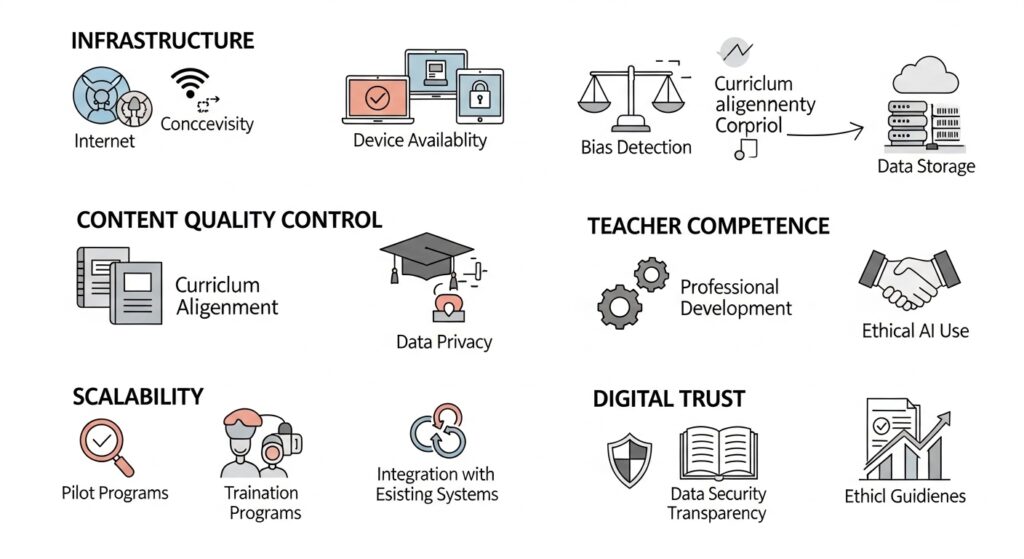
If you answered “no” to even one of these questions, your school is not ready for AI adoption. But here is the encouraging truth: readiness can be built. The gap is not insurmountable; it is a matter of implementing the right institutional infrastructure before deploying AI tools.
Successful AI adoption requires a platform approach, not a tools approach. The platform must handle content governance, institutional oversight, quality assurance, and workflow integration, transforming individual teacher productivity into a school-wide digital learning infrastructure.
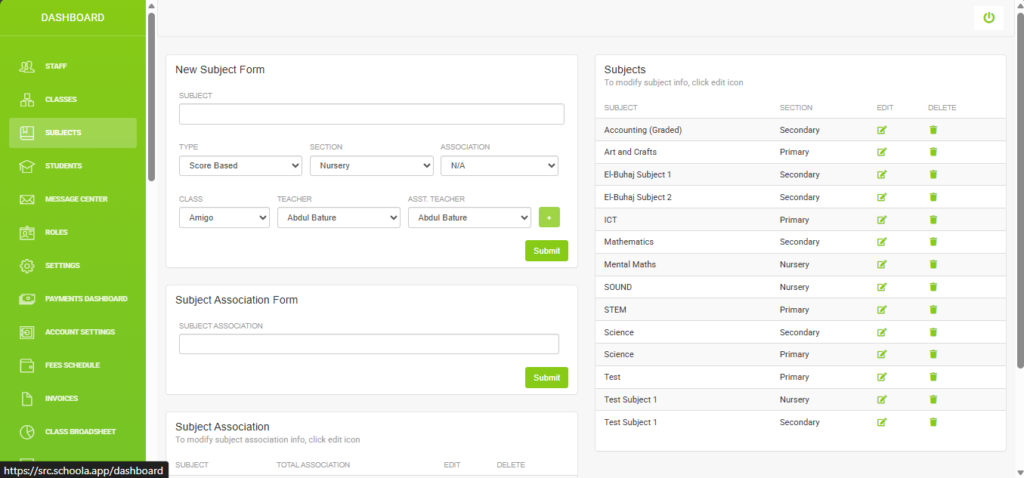
Curri SRC (Secure Resource Center) was built specifically to solve this institutional readiness gap. It functions as the central nervous system for school-wide digital content, enabling principals and administrators to collect, review, approve, and distribute all teacher-created lessons from a single dashboard.
Here is how the system addresses each readiness question:
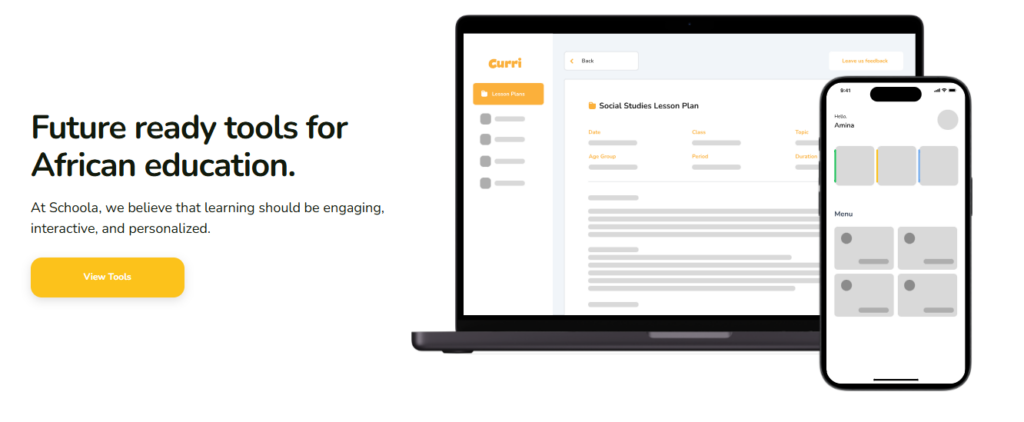
Over 2,000 Nigerian schools currently use Curri SRC to govern their digital content. These schools did not start with AI readiness (they built it systematically). Many began with Schoola‘s earlier Learning Management System in 2021, serving 40+ schools and 15,000+ learners. When COVID-19 hit, the platform evolved into an emergency School Results and Record Centre, enabling schools to manage learning remotely during lockdowns, earning recognition as one of the Top 10 AI-driven startups representing Nigeria at GITEX Global Dubai in 2020.
That emergency response system revealed a deeper truth: schools need institutional infrastructure for digital learning, not just content delivery tools. Curri SRC represents the evolution of that insight: purpose-built infrastructure that enables schools to adopt AI without losing institutional control, quality standards, or accountability.
Your school will adopt AI. The only question is whether you will do it with the institutional readiness that ensures success, or without it and join the long list of failed digital transformation initiatives.
Take this assessment seriously.
Explore how Curri SRC provides the institutional infrastructure your school needs for AI readiness, or contact us for a readiness consultation to assess your specific context and build a systematic path to digital transformation.