Stop Teaching “A-B-C”: Why Letter Sounds are the Key to Your Classroom’s Literacy Success
In many classrooms, the first major breakthrough in literacy instruction happens when teachers realise that recognising letters is not the same as reading.
Children may confidently recite the alphabet and still struggle to decode simple words independently. In effective early literacy instruction, helping children move from letter recognition to decoding is one of the most important foundations of reading development.
As we explored previously, this often happens because early instruction places greater emphasis on letter identification than on sound awareness and decoding.
But once teachers understand this distinction, another question naturally follows:
What does classroom instruction begin to look like after this realisation?
In many cases, stronger literacy instruction begins with small but intentional pedagogical adjustments, particularly in how teachers draw children’s attention to sounds during reading and writing activities.
Below are three instructional Adjustments that can significantly strengthen early decoding development, especially in multilingual and resource-constrained classrooms.
1. Strengthening Early Literacy Instruction Through Sound Awareness
One of the most common patterns in early literacy classrooms is heavy reliance on letter-name instruction.
Teachers point to a symbol and ask:
“What letter is this?”
Children respond:
“Bee.” “Ess.” “Tee.”
While letter names are important, reading development depends more directly on a child’s ability to connect letters to sounds during decoding.
A learner reading the word sun does not process the word by saying:
“Ess-You-En.”
Instead, the learner must access the sounds: /s/ – /u/ – /n/
and blend them into a recognisable spoken word.
This distinction may appear small, but pedagogically it is significant.
Research in early literacy consistently shows that phonemic awareness, the ability to hear and manipulate sounds in spoken words plays a major role in reading development. When instruction overemphasises alphabet recitation without sufficient attention to sound-symbol relationships, many children struggle to transition into independent reading.
This does not mean teachers should stop teaching letter names altogether. Rather, sounds should become equally visible within classroom interaction.
For example:
When introducing letters, during word reading, while writing, and during oral language activities.
Simple classroom language can make a difference:
“Yes, this letter is called ‘Ess.’ What sound does it make when we read?” That helps learners connect print to spoken language more meaningfully.
2. Using Sound Blending to Strengthen Decoding Skills
For beginning readers, blending sound is a cognitive process that often requires repeated modelling and guided practice. Many children can identify individual sounds correctly but still struggle to combine them fluently into complete words.
This is where oral blending activities become important.
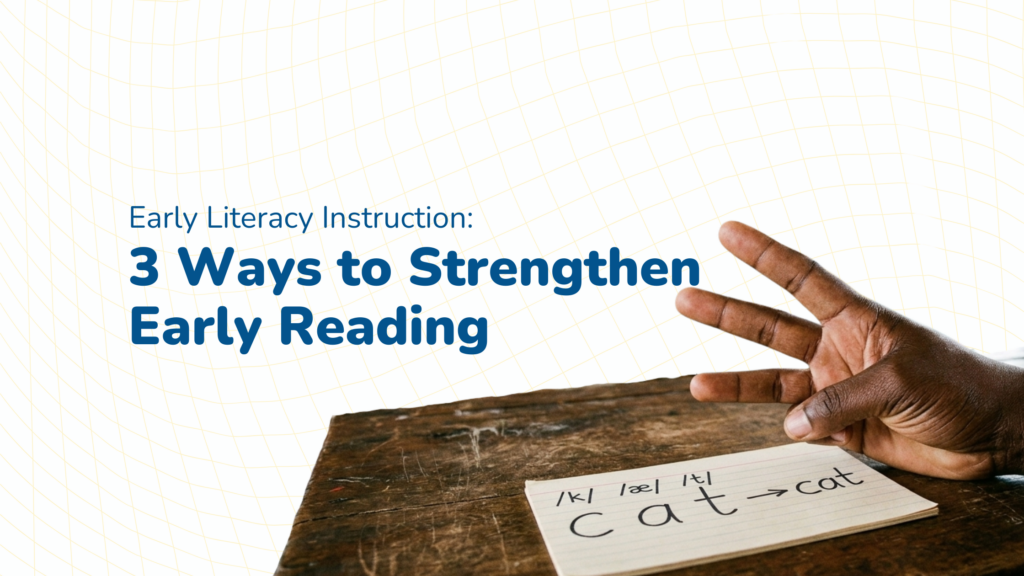
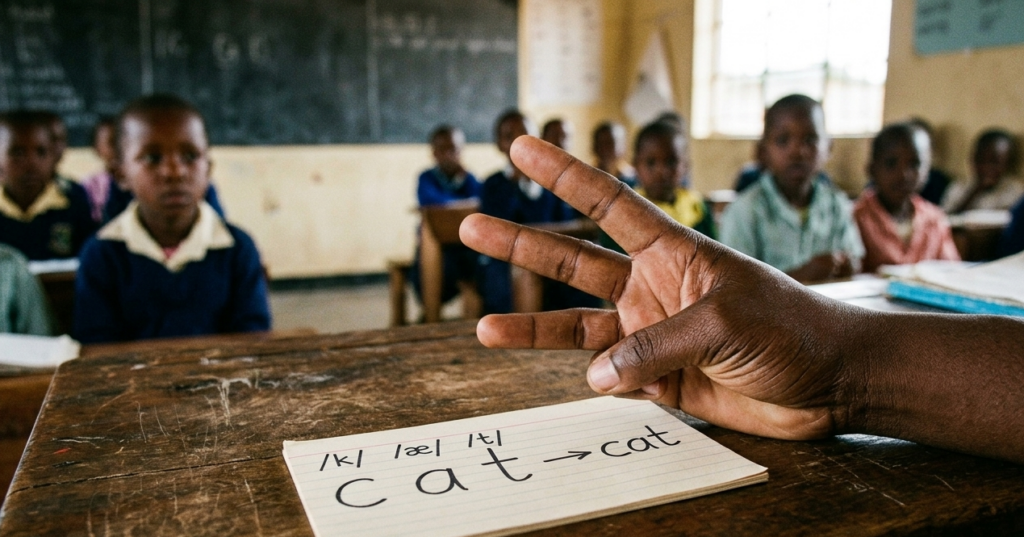
One useful strategy is finger blending:
One finger represents one sound, and the movement across the fingers represents blending.
For example, while reading cat:
first finger: /k/
second finger: /a/
third finger: /t/
Then the teacher guides learners to blend the sounds smoothly:
“cat.”
This may seem simple, but it supports several important aspects of literacy development:
Sound segmentation
Auditory processing
Sound sequencing
Decoding fluency
More importantly, it helps transform reading from an abstract activity into something children can physically and mentally track.
In overcrowded classrooms, strategies like this are also useful because they require minimal materials while still increasing learner participation.
Children do not always need expensive literacy tools to develop decoding skills. Often, they need clearer instructional routines that make the structure of language more visible.
3. Organising Literacy Instruction Around Sounds
Traditional alphabet displays organise learning according to sequence: A, B, C, D.
But early readers benefit from understanding how sounds function within actual words.
This is one reason many literacy educators now emphasise the value of sound-focused instructional displays, sometimes called sound walls.
Unlike alphabet charts, sound walls organise letters according to the sounds they represent. This helps learners think about language through pronunciation and decoding rather than memorisation alone.
For example:
learners searching for how to write sun begin by identifying the /s/ sound,
not simply recalling the visual position of the letter S in the alphabet.
In low-resource contexts, this does not require elaborate classroom decoration. Teachers can create sound-focused displays using:
Cardboard
Manila paper
Chalkboard sections
Handwritten cards
Or locally available materials
The pedagogical goal is helping learners connect spoken sounds to written symbols more intentionally. This becomes especially powerful in multilingual classrooms, where learners are simultaneously navigating unfamiliar vocabulary, pronunciation patterns, and new print systems.
Why These Literacy Instruction Adjustments Matter
When children begin understanding that reading is fundamentally about connecting sounds to print, several important things begin to change.
Learners often become:
More willing to attempt unfamiliar words
Less dependent on memorisation
More confident during writing
More capable of self-correction while reading
This matters because fluent reading develops when children understand how written language works, and that understanding grows gradually through repeated opportunities to hear sounds, manipulate sounds, connect sounds to letters, and blend those sounds into meaningful words.
Small Literacy Instruction Shifts Can Improve Reading Outcomes
In many schools, literacy challenges are discussed as though they require large-scale interventions before improvement is possible.
But sometimes meaningful change begins with something smaller:
A teacher asking about sounds more intentionally,
Slowing down blending practice,
Or helping learners hear language differently.
These may appear minor from the outside. Inside the classroom, however, they often change how children experience reading altogether. Because for many beginning readers, the real breakthrough discovering that written words can be decoded independently—sound by sound.