
Understanding Early Literacy Instruction
One of the more confusing moments in early literacy instruction is watching a child confidently recite the alphabet while struggling to read a simple three-letter word.
A learner can identify A, B, C, and D without hesitation, yet pause completely when asked to read a word like cat or sun. For many teachers, this contradiction feels puzzling. If the child knows the letters, why is reading still difficult?
The answer lies in an important distinction that early literacy instruction does not always make clearly enough: knowing letter names is not the same as understanding how written language works. In literacy instruction, children learn to read not simply by recognising letters, but by connecting sounds to symbols and blending them into words.
And for many children, that is where the real challenge begins. This challenge sits at the centre of effective early literacy instruction and foundational reading development.
The Difference Between Knowing Letters and Decoding Words
In many classrooms, alphabet instruction focuses heavily on letter identification:
-
- “What letter is this?”
-
- “Can you sing the alphabet?”
-
- “Point to the letter B.”
These activities are not meaningless. Letter recognition matters. But problems emerge when literacy instruction stops there.
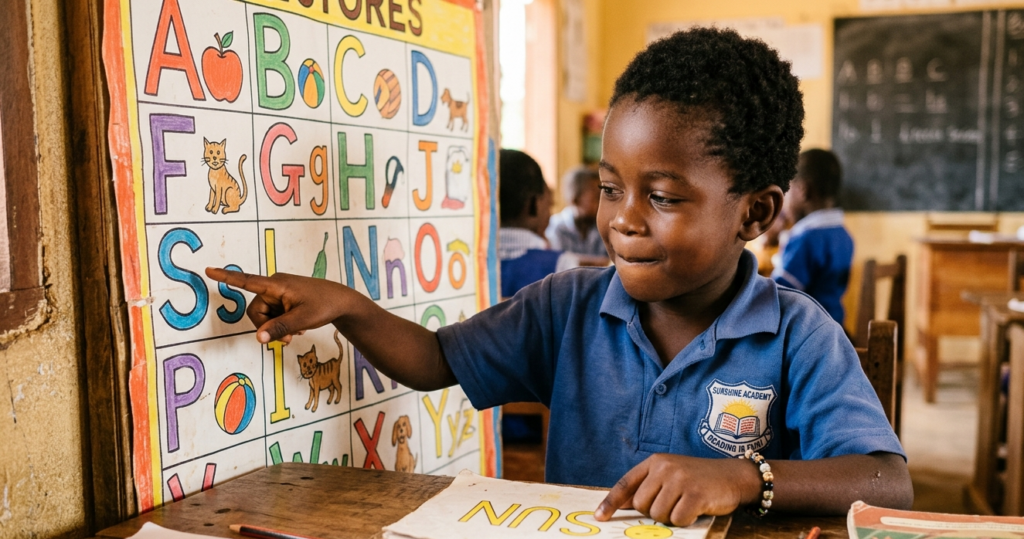
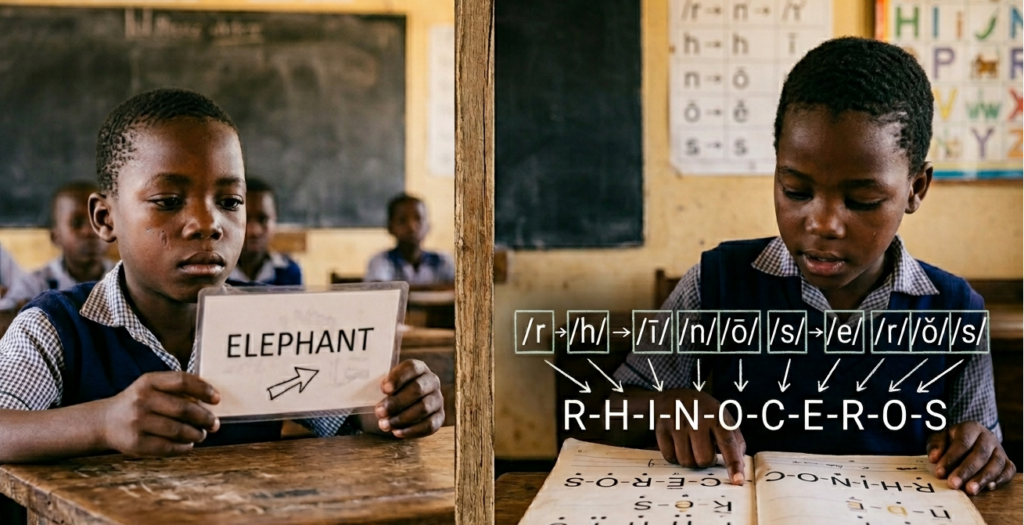
A child may know that the symbol B is called “Bee” and still struggle to use it while reading. This is because reading requires something more complex: the ability to connect written symbols (graphemes) to the sounds they represent (phonemes).
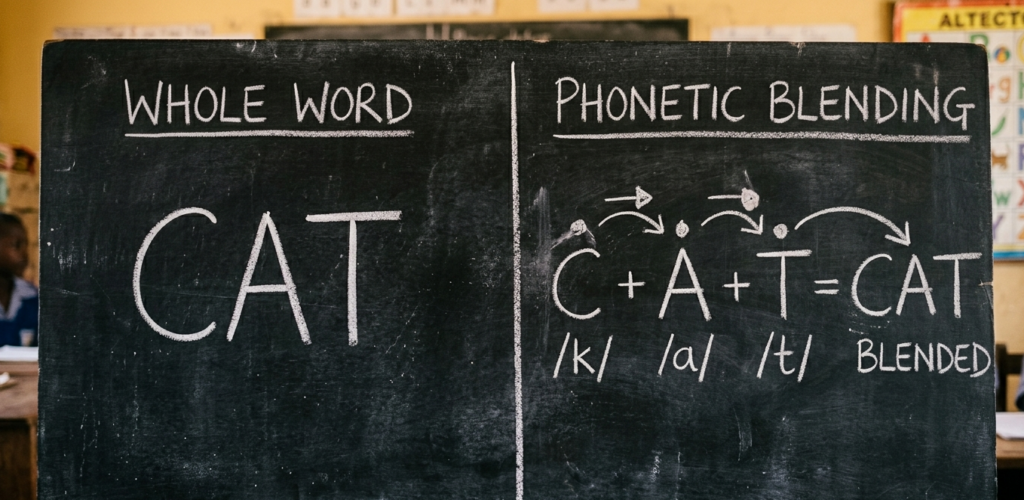
When a learner encounters the word cat, successful reading depends on hearing and blending the sounds:
/k/ – /a/ – /t/
not reciting the letter names:
“See – Ay – Tee.”
This process is known as decoding. Decoding is one of the most important skills in teaching children to read independently, and it forms one of the foundational building blocks of early reading development.
Without strong sound awareness, children often memorise words visually rather than learning how to read unfamiliar words independently.
Why Early Literacy Instruction Matters in African Classrooms
This distinction becomes particularly important in multilingual learning environments, which are common across many African schools.
Many children are:
-
- learning to read in a language different from the primary language spoken at home,
-
- entering school with uneven exposure to print,
-
- or encountering formal literacy instruction for the first time inside overcrowded classrooms with limited instructional resources.
In these contexts, reading instruction cannot rely heavily on memorisation alone. Learners need repeated opportunities to hear sounds clearly, connect them to print, and manipulate them orally before reading becomes automatic.
This is one reason why some children appear “slow” in reading when the real issue is not intelligence, but insufficient support in phonemic awareness and decoding development.
When teachers shift attention from alphabet recitation toward sound awareness, many learners begin to access reading more confidently.
Strong literacy instruction helps children move from alphabet recognition to real reading fluency.
Why Phonemic Awareness Matters in Early Reading
Strong readers do not process words letter-by-letter indefinitely. Over time, they begin recognising familiar spelling patterns automatically. But this automaticity develops gradually through repeated sound-symbol connections.
Before children can read fluently, they must first understand that:
-
- Words are made of sounds,
-
- Sounds can be separated,
-
- And letters represent those sounds in print.
This may seem obvious to adults because in early reading development, this understanding forms the basis of independent reading. But for beginning readers, it is a major conceptual breakthrough.
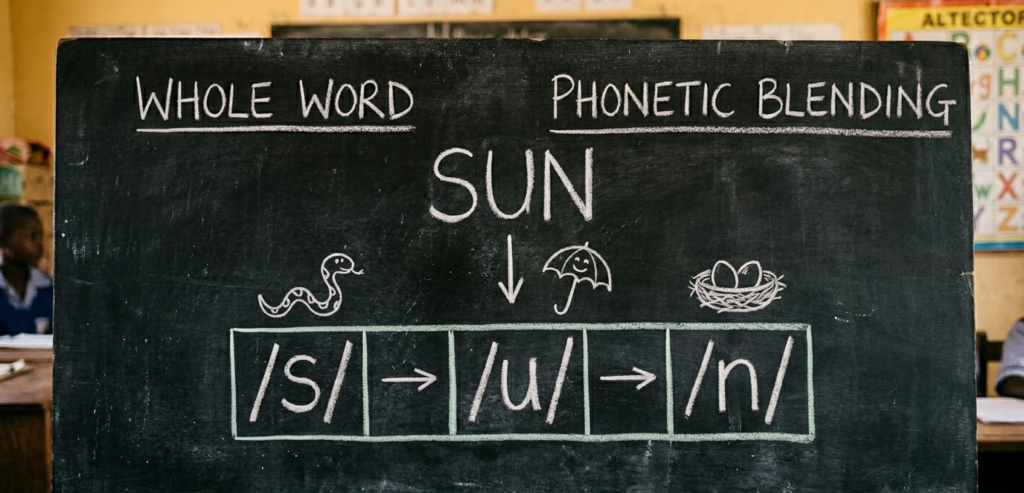
A child who can hear that sun contains three separate sounds:
/s/ – /u/ – /n/
is already developing the foundations needed for independent reading.
Three Teaching Strategies That Strengthen Early Reading Development
Meaningful literacy instruction does not always require expensive materials or highly scripted programmes. Often, small pedagogical shifts produce significant improvements.
1. Prioritise Sounds Alongside Letter Names
Instead of asking only:
“What letter is this?”
teachers can also ask:
“What sound does this letter make?”
This helps learners connect visual symbols to spoken language rather than memorising letters in isolation.
For example:
-
- The letter S has the name “Ess,”
-
- but during reading, learners must recognise the sound /s/.
This distinction strengthens decoding ability and helps children process words more efficiently.
2. Use Oral Blending Frequently
Many children need opportunities to hear how individual sounds combine into complete words.
A simple oral blending routine can help:
-
- Say the sounds slowly:
/m/ – /a/ – /t/
- Say the sounds slowly:
-
- Then blend them together:
“mat.”
- Then blend them together:
Finger-counting can make this process more concrete, especially for younger learners:
-
- one finger per sound,
-
- then a smooth blending motion across the sounds.
This supports auditory processing and helps learners understand that words are made of connected sound units rather than isolated letters.
3. Organise Learning Around Sounds, Not Just Alphabet Order
Traditional alphabet charts organise letters according to sequence:
A, B, C, D.
But early readers often benefit more from understanding how sounds function within words.
Even in low-resource classrooms, teachers can group sounds visually using:
-
- chalkboard sections,
-
- handmade cards,
-
- cardboard displays,
-
- or manila paper charts.
The goal is not decoration. The goal is helping learners think about written language through sound patterns and sound-symbol relationships.
This becomes especially useful when children attempt independent spelling and writing.
Why Reading Development Is More Than Memorisation
One of the most important shifts in literacy instruction occurs when teachers stop viewing reading primarily as memorising words and begin understanding it as a process of sound-symbol mapping.
Children who struggle with reading are often asked to repeat words more frequently when what they actually need is stronger support in:
-
- hearing sounds,
-
- distinguishing sounds,
-
- blending sounds,
-
- and connecting those sounds to print.
This distinction matters because memorisation eventually reaches its limit. Effective phonics instruction and phonemic awareness help children read unfamiliar words independently.
And that independence changes the trajectory of literacy development entirely.
A Larger Question in Literacy Instruction
Early reading instruction sometimes becomes overly focused on visible performance:
-
- alphabet recitation,
-
- copying exercises,
-
- chorus repetition,
-
- or word memorisation.
But literacy development is deeper than performance. It involves helping children understand how written language represents spoken language.
That process requires intentional pedagogy.
It requires teachers to move beyond asking:
“Can this child name letters?”
toward asking:
“Can this child use sounds to unlock words independently?”
The difference between those two questions may appear small.
In practice, it changes how reading is taught altogether.