

So everyone is talking about AI for lesson planning, right? “It is free!” they say. “Just type what you need and boom, instant lesson plan!”
And yeah, technically, they are not wrong. ChatGPT will not bill you for its free version. Most AI tools will not ask for your card details at the basic level. But can we have an honest conversation here?
“Free” and “costless” are two very different things.
Look, we have sat with enough teachers in staff rooms, after school hours, during those honest moments when everyone is tired, to know the truth. Nothing that promises to make your life easier comes without some kind of trade-off. So, AI? Same deal. You are absolutely paying. Just not with money.
Sometimes what you are giving up is worth it. Sometimes it is not. And honestly, that is what we want to talk about today, not as people trying to sell you something, but as folks who care about what actually works for Nigerian and African teachers.
Okay, so here is what typically happens. A teacher hears about AI lesson planning (maybe from a colleague, maybe on social media). They try it out. Type in “create a biology lesson on photosynthesis for SS2.” Two minutes later, there is a complete lesson plan staring back at them.
Mind. Blown.
For about five minutes. Then you actually read what the AI gave you.
“Use fall leaves to demonstrate seasonal changes in photosynthesis.” Fall? In Lagos? Or maybe the AI is suggesting students research online at home, forgetting that half of your class shares one phone between three siblings. It is referencing curriculum standards from Cambridge or America, not NERDC. The materials list includes things your school does not have and probably never will.
So now you are editing. Rewriting examples. Swapping out activities. Checking that objectives actually match what you are supposed to be teaching. Forty-five minutes later, you have basically rewritten the whole thing anyway.
That is the real cost right there. Time. Mental energy. The frustration of thinking you had found a shortcut only to discover it is more like a detour. And yes, we can hear some people at the back saying (“Why not use proper prompt engineering?”), forgetting that most teachers in Nigeria and Africa as a whole have a rudimentary knowledge of how to utilise AI tools properly. Talk more about framing prompts effectively.
And look, we are not saying this to discourage anyone from using AI tools designed for African education. We are saying it because teachers deserve to know what they are getting into. The promise is always “save time!” but the reality is often “spend time differently, and maybe not in ways that actually help.”
Let us talk about the stuff nobody mentions in those excited “AI changed my teaching life!” posts on Facebook.
First up: your creativity takes a hit. You know that spark you get when you are planning and suddenly connect two ideas that will make your students go “ohhh!”? Like explaining ecosystems through the relationship between native everyday trees and animals (things they see every day on their way to school). Or teaching ratios using how their mothers measure rice and beans for jollof, where getting the proportion right is the difference between perfect party jollof and something nobody wants to eat. Or connecting storytelling traditions to narrative writing by referencing the folktales they grew up telling. AI does not do that. And at most, it does a poor job.
What happens over time (and we have watched this happen) is that teachers stop having those creative moments as often. You get used to AI’s structure. You start thinking inside its box. Your lessons become… fine. Competent. But they lose that thing that made them yours.
Over-dependence is sneaky. Month one, you are just using AI for the tedious structural stuff. In month three, you are automatically opening ChatGPT before you even think about the lesson yourself. In month six, especially if you are a newer teacher, you are not entirely sure if you remember how to scaffold a lesson from scratch.
All these beg the question. What happens when the internet goes down? When does the platform change its rules? When you are at a school with no connectivity?
Quality is all over the place, too—same prompt, different days, wildly different results. Monday’s lesson plan is brilliant; creative activities, good pacing, and actually useful content. On Wednesday, you use almost the same words and get garbage. You never quite know what you are getting until you have already spent the time on it.
Here is what else you are trading away:
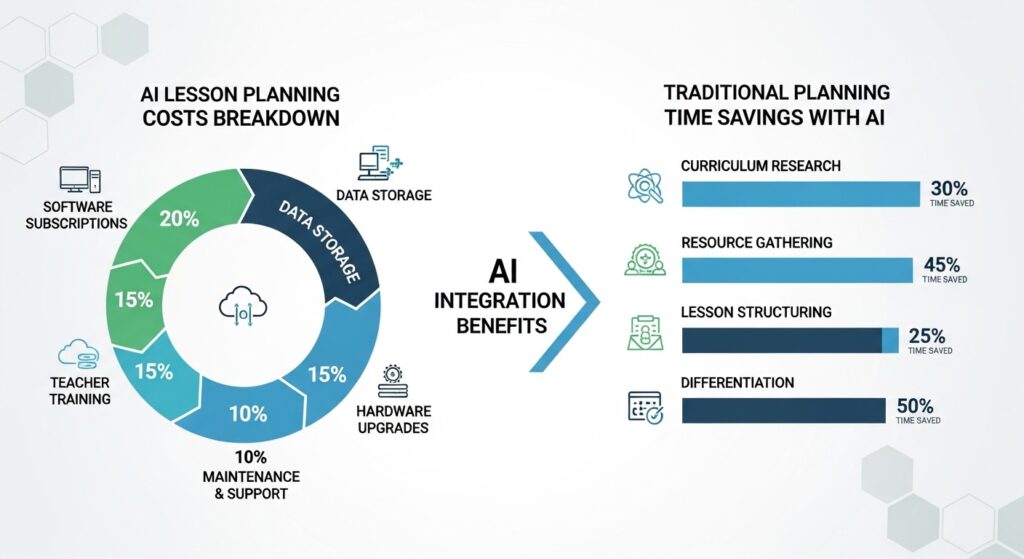
The learning curve is real, too. Everyone acts like prompting AI is easy. “Just type what you want!” Sure. Except that actually getting useful content takes practice. Hours of it. You are learning a whole new skill (how to talk to AI) instead of getting better at the teaching skills you actually need. Research on teacher workload shows that learning new educational technology often adds to teacher stress in the short term, even when it promises long-term benefits.
And honestly? The AI does not know your context. Does not know what Nigerian classrooms are really like. Does not understand that you are teaching the Nigerian curriculum, not some international version. Does not account for the fact that during the rainy season, half your class might not make it to school. Does not know about the nonexistent power supply, the shared textbooks, or the realities of teaching here.
That contextual blindness? That might be the most expensive cost of all.
Let us get into the specifics of where this whole thing breaks down.
You ask for a lesson on fractions. You get a lesson on fractions. Technically correct. Structurally sound. Completely useless for your actual classroom.
Because the AI does not know that Chioma learns best with visual examples. Does not know that Tunde is still struggling with division and needs extra support. Does not remember that last week’s lesson is the perfect setup for this week’s topic. It just generates content in a vacuum.
These international AI models were trained mostly on Western content. So you get:
You end up spending more time removing and replacing these references than you would have spent just writing the lesson yourself.
Technical problems create their own mess. Internet down? No lesson plan. Platform having issues? No lesson plan. Hit your monthly limit on the free version? No lesson plan. Suddenly, you are depending on infrastructure that, let us be real, is not always dependable in Nigeria. UNESCO’s research on EdTech in Africa highlights that internet connectivity remains one of the biggest barriers to the adoption of educational technology across the continent.
Then there is the privacy thing that nobody really talks about. You are feeding information about your students, your class, and sometimes even names into these systems. Where is that data going? Who owns it? What happens to it? Most free AI tools are vague about this stuff.
But you want to know the sneakiest problem?
The AI gives you something usable. Not great. Not what you would normally create if you had time and energy. But usable. And when you are exhausted, when you have got 47 other things demanding your attention, “manageable” starts looking pretty attractive.
So you stop pushing for excellence. You settle. And your students? They get good-enough teaching instead of your best.
Okay, we need to be fair here. AI is not all problems and hidden costs. When used properly (and that “properly” is doing a lot of work in that sentence), AI can genuinely help.
The real question is not “Is AI useful?” It is “Is it useful for you, in your specific situation?”
Right, so now we get to talk about what we have built and why we built it. But we are going to be straight with you, this is not magic either. It is just designed with Nigerian and African teachers in mind, instead of being a global tool that has been adapted.
Curri AI for teachers starts from the Nigerian curriculum. Not adapted. Not modified. Built from NERDC standards from the ground up. When you generate a lesson plan, it is not trying to shoehorn British content into a Nigerian context. It knows what Primary 4 in Nigeria actually looks like.
The whole philosophy is teacher control plus AI help, not AI replacement. You are not asking a machine to teach for you. You are asking it to handle the mechanical stuff (formatting, standards alignment, the structural basics) so you can focus on the teaching parts that actually need you. Your creativity, your knowledge of your students, your experience.
Working offline matters here in ways it might not elsewhere. We know internet connectivity is inconsistent. We have designed around that reality instead of pretending it does not exist.
The 2-minute thing sounds like marketing hype, but here is what we mean: two minutes for the structure. The standards cross-checking. The objective formatting. The basic framework. You still bring the good stuff, your teaching style, your examples, your understanding of what your students need. You are just not spending 45 minutes on the boring mechanical parts first.
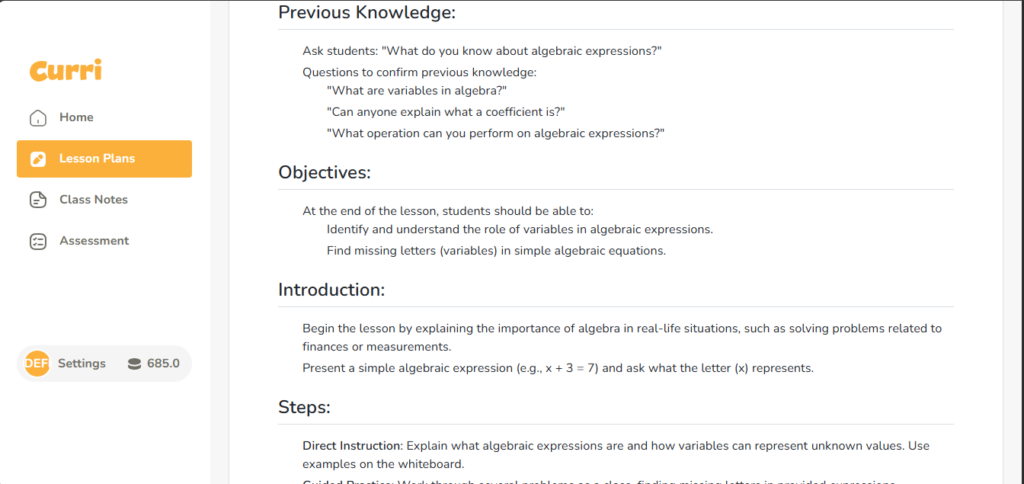
Teachers using this are telling us things like:
“With the traditional method, sometimes I spend like an hour. With Curri, it has been great. Less stressful, less time-consuming. It has made my work easier and my notes faster. It gives me more ideas.”
– Blessing
“I have like 40-something lesson notes I have made from Curri… It has reduced my workload by a very significant amount of time. I do not stress too much about my lesson.”
– Teacher using Curri AI
The feedback we keep hearing is that it solves the specific problems Nigerian teachers face instead of creating new ones. It understands the context. It respects your expertise. It does not try to replace you; it just handles the parts of lesson planning that do not actually need a human brain.
When you partner with Schoola, you are working with people who have sat in Nigerian staff rooms, talked to Nigerian teachers, and understood the actual daily realities you are dealing with. We are building tools that make sense for your situation, not trying to adapt global solutions that do not quite fit.
So after all this, where does it leave you? With some decisions to make, honestly.
When AI makes sense: You have taught this topic before and just need a fresh structure. You are doing skills practice that follows established patterns. You need help with the administrative scaffolding. Not only that, but you are genuinely stuck and need inspiration. You want to save time on the mechanical parts so you can focus on the creative teaching work.
When to stick with manual planning: First time teaching something new, you need to figure out your approach. Complex topics that need careful scaffolding tailored specifically to your students. Lessons where your relationship with your students is driving the whole thing. Creative units where your personal touch IS the point.
Keeping quality high with AI comes down to one thing: treat it like a tool, not a teacher. You would not let a calculator teach math. You would not let a dictionary teach essay writing. Same here. AI structures, you teach. AI suggests, you decide. AI generates, you refine and customise.
Red flags that AI is not working:
Here is our honest take after watching hundreds of teachers navigate this: AI lesson planning costs something. Time learning it. A bit of your creative autonomy. Mental energy, managing it. But with the right tools, ones built for your actual context, those costs can buy you something valuable. More time for the teaching work that genuinely needs your human expertise.
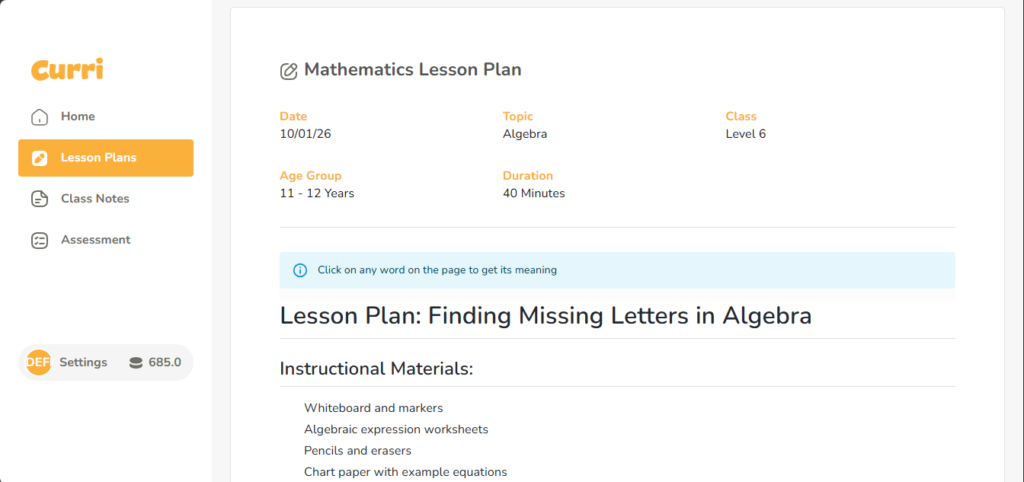
The future-ready teaching platform does not do everything for you. It makes you better at the things only you can do. Inspire your students. Connect with them. Adapt to their needs in real-time. Understand what they are really struggling with. Care about their growth.
Technology should make those things easier, not replace them.
Want to explore how AI can support your teaching without taking over the parts that matter most?
Contact us and let us have an honest conversation about what actually works in Nigerian classrooms.
Because teaching is human work. AI can help with the mechanics. But only you can make it meaningful.